

XIX The Sacraments
The seven sacraments
Baptism, Confirmation, the Eucharist, Penance, the Anointing of the Sick, Holy Orders and Matrimony — what each one is, how it is given, and how to ask for it.
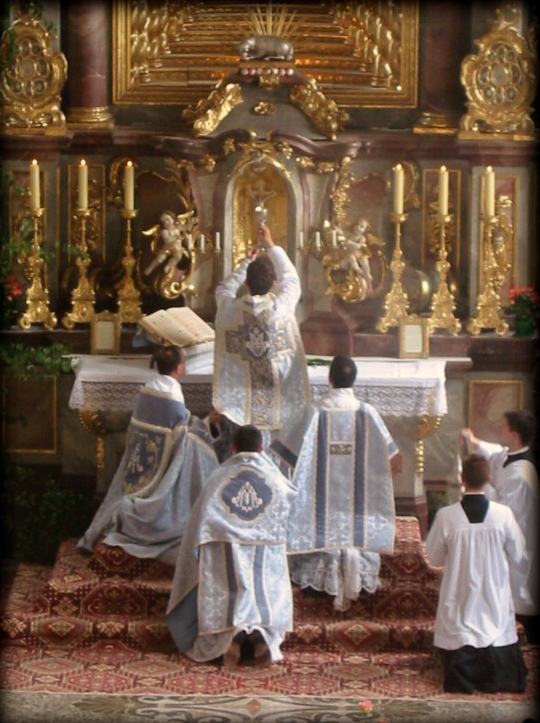
Photo: FSSP – Fraternitas Sacerdotalis Sancti Petri · Attribution
The sacraments are efficacious signs of grace, instituted by Christ and entrusted to the Church, by which divine life is given to us (CCC 1131). They touch every stage of life: they give birth and growth, healing and mission.
Sacraments of Christian initiation
Baptism
The gateway to life in the Spirit: it frees from sin, makes us children of God and members of the Church.
Water is poured (or the person immersed) with the words “I baptize you in the name of the Father, and of the Son, and of the Holy Spirit.” It is received once, and in necessity anyone may baptize.
Confirmation
Completes the grace of Baptism with the gift of the Holy Spirit, binding us more perfectly to the Church.
The bishop (or a priest he delegates) anoints the forehead with chrism, saying “Be sealed with the Gift of the Holy Spirit.” It is received once.
The Eucharist
The source and summit of the Christian life: the Body and Blood of Christ, his sacrifice made present, our food for eternal life.
At Mass the bread and wine become the Body and Blood of Christ. Catholics who are free of grave sin receive Communion, after fasting for one hour.
Sacraments of healing
Penance and Reconciliation
Christ forgives the sins committed after Baptism and reconciles us with God and the Church.
The penitent confesses to a priest, receives a penance and the absolution. It may be received as often as needed.
Anointing of the Sick
Strength, peace and courage for those seriously ill or weakened by age; it unites the sick to the Passion of Christ.
A priest anoints the forehead and hands with blessed oil and prays over the sick person. It can be received again if the illness worsens or returns.
Sacraments at the service of communion
Holy Orders
The sacrament by which the mission Christ entrusted to his apostles continues in the Church: bishops, priests and deacons.
A bishop lays hands on the candidate and prays the prayer of consecration.
Matrimony
The covenant by which a man and a woman give themselves to each other for life, for their good and for the gift of children.
In the Latin Church the spouses themselves are the ministers: they exchange their consent before the Church.
Becoming Catholic
“Come and see”
Adults who wish to become Catholic are welcomed through the catechumenate, restored by the Second Vatican Council: a journey in several steps that reaches its summit when Baptism, Confirmation and the Eucharist are received together, usually at the Easter Vigil (CCC 1229–1233).
- Enquiry. Get in touch with a Catholic parish. A priest or catechist will listen to your questions and accompany you.
- The catechumenate. A time of learning the faith, prayer and taking part in the life of the parish.
- Election and preparation. In Lent the bishop calls those who are ready; the weeks before Easter are a time of purification.
- The sacraments of initiation. Baptism, Confirmation and first Communion — usually at the Easter Vigil.
Christians already validly baptized in another church or community are not baptized again, since Baptism cannot be repeated (CCC 1272); they are prepared for and received into full communion with the Catholic Church.
Drawn from the Catechism of the Catholic Church, Part Two (“The Celebration of the Christian Mystery”). For the exact requirements — ages, preparation, documents — ask your parish, since they follow the norms of each diocese.