

III Pilgrimage
The Bread of Life
Eucharistic miracles kept and venerated by the Church — where they happened, what happened, and where you can pray before them today.
Photo: Justinawind · CC BY-SA 4.0
A sign, not a proof
The Church believes that Christ is truly present in every consecrated Host, whether or not anything is seen. Eucharistic miracles are signs that strengthen faith: many have been venerated for centuries, some have been studied by scientists, and a few recent ones were recognised by the local bishop after long investigation. For a richly documented exhibition, see the international exhibition prepared by Saint Carlo Acutis at miracolieucaristici.org.
Approved recognised by the ChurchVenerated venerated for centuriesUnder study investigated, no formal decree
VIII8th century
Lanciano, Italy
The Miracle of Lanciano
Venerated Venerated for centuries as a relic
In about 750 a priest-monk who doubted the Real Presence saw the Host turn into flesh and the wine into blood as he spoke the words of consecration. The relics, the Flesh and the Blood coagulated into five unequal clots, are still kept in the church of St Francis; a scientific study in 1970–71 identified the Flesh as heart muscle tissue.
- Kept at
- Sanctuary of the Eucharistic Miracle (Church of San Francesco)
- Address
- Corso Roma, 66034 Lanciano, Italy
Photo: AFC photo · CC BY-SA 3.0
XII12th century
Ferrara, Italy
The Miracle of Ferrara
Venerated Venerated for centuries as a relic
During Easter Mass blood spurted from the Host as it was broken and stained the vault above the altar. The marks can still be seen in a side chapel of the basilica.
- Kept at
- Basilica of Santa Maria in Vado
- Address
- Via Borgovado, 44121 Ferrara, Italy
Photo: graph by Mike Peel (www.mikepeel.net). · CC BY-SA 4.0
Augsburg, Germany
The Miraculous Good of Augsburg
Venerated Venerated for centuries as a relic
In 1194 a woman took a consecrated Host home and kept it sealed in wax. When she confessed five years later and the wax was opened, the Host had become bleeding Flesh. The bishop had it carried to the cathedral and then back to the Holy Cross convent, with a yearly commemoration; it is known as the Wunderbarliches Gut, the Miraculous Good.
- Kept at
- Church of the Holy Cross (Heilig Kreuz)
- Address
- Heilig-Kreuz-Straße, 86152 Augsburg, Germany
Photo: Alois Wüst · CC BY-SA 3.0
XIII13th century
Daroca, Spain
The Holy Corporals of Daroca
Venerated Venerated for centuries as a relic
In 1239, before a battle against the Moors at the castle of Chio (Luchente, Valencia), a priest hid six consecrated Hosts in a corporal during a surprise attack. After the victory he found the Hosts drenched in blood. A mule carrying the corporal stopped at Daroca, where it is still venerated in the collegiate basilica.
- Kept at
- Collegiate Basilica of Santa María de los Sagrados Corporales
- Address
- Plaza de España, 50360 Daroca, Spain
Photo: Diego Delso · CC BY-SA 3.0
Santarém, Portugal
The Holy Miracle of Santarém
Venerated Venerated for centuries as a relic
A jealous woman stole a consecrated Host for a sorceress who promised her a love potion; wrapped in a cloth, the Host began to bleed. The Host, preserved in a crystal reliquary, is still displayed in the Church of St Stephen, now the Shrine of the Holy Miracle.
- Kept at
- Church of the Holy Miracle
- Address
- Largo do Milagre, 2000-095 Santarém, Portugal
Photo: Arquidiocese de Braga · CC BY 3.0
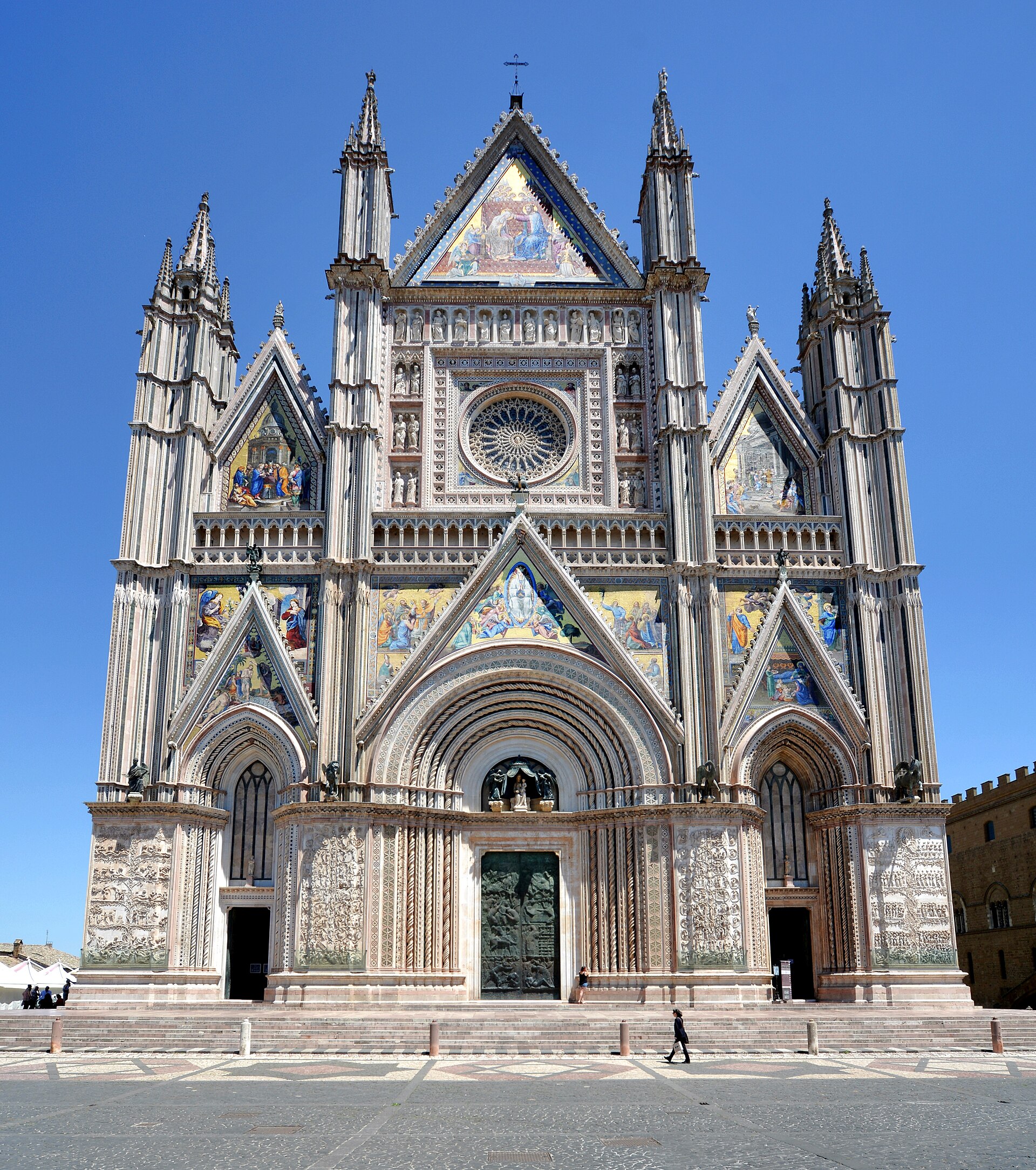
Bolsena and Orvieto, Italy
The Miracle of Bolsena
Approved Recognised by the Church
A German priest troubled by doubt saw blood flow from the Host onto the corporal while celebrating Mass in Bolsena. Pope Urban IV, then in nearby Orvieto, instituted the feast of Corpus Christi the following year. The corporal is kept in Orvieto Cathedral.
- Kept at
- Orvieto Cathedral (and Basilica of Santa Cristina, Bolsena)
- Address
- Piazza del Duomo, 05018 Orvieto, Italy
Photo: Justinawind · CC BY-SA 4.0
Offida, Italy
The Miracle of Offida
Venerated Venerated for centuries as a relic
In 1273 a woman of Lanciano named Ricciarella, advised by a witch, put a consecrated Host on the fire to make a love potion, and it turned into bleeding flesh. Seven years later she confessed to the Augustinian prior Giacomo Diotallevi, a native of Offida, who took the relics to his home town. They are kept in a gilded silver cross in the Sanctuary of Sant’Agostino.
- Kept at
- Sanctuary of Sant’Agostino
- Address
- Offida, Province of Ascoli Piceno, Italy
Photo: Cristiano Marchegiani · CC BY-SA 2.5
O Cebreiro, Spain
The Miracle of O Cebreiro
Venerated Venerated for centuries as a relic
One snowy winter day around 1300 a farmer, Juan Santín, struggled through the storm to Mass while the priest scorned his effort, until the Host became flesh and the wine blood. Queen Isabella later had a crystal reliquary made, and the chalice, paten and relics are still kept in the church of Santa María la Real.
- Kept at
- Church of Santa María la Real
- Address
- O Cebreiro, 27671 Pedrafita do Cebreiro, Lugo, Spain
Photo: Bjørn Christian Tørrissen · CC BY-SA 3.0
XIV14th century
Walldürn, Germany
The Holy Blood of Walldürn
Venerated Venerated for centuries as a relic
A priest knocked over the chalice after consecration; the spilt wine formed on the corporal an image of the crucified Christ surrounded by eleven heads crowned with thorns. Walldürn has been a pilgrimage town ever since.
- Kept at
- Basilica of St George
- Address
- 74731 Walldürn, Germany
Photo: Fritz Geller-Grimm supported by Rüdiger Wandke · CC BY-SA 3.0
Cascia, Italy
The Miracle of Cascia
Venerated Venerated for centuries as a relic
Near Siena in 1330, a priest carrying the Eucharist to a sick peasant carelessly placed the Host between the pages of his breviary. When he opened it, the Host had bled onto both pages. The relic was entrusted to the Augustinians of Cascia and is kept in the Basilica of St Rita.
- Kept at
- Basilica of St Rita of Cascia
- Address
- Piazza San Francesco, 06043 Cascia, Italy
Photo: LigaDue · CC BY-SA 4.0
Amsterdam, Netherlands
The Miracle of Amsterdam
Approved Recognised by the Church
A dying man vomited the Viaticum he had received, and the Host was thrown into the fire — but was found the next morning unharmed in the flames. Every March thousands of pilgrims walk the Stille Omgang, a silent night procession through the city.
- Kept at
- Begijnhof Chapel (Stille Omgang)
- Address
- Begijnhof 30, 1012 WT Amsterdam, Netherlands
Seefeld in Tirol, Austria
The Miracle of Seefeld
Venerated Venerated for centuries as a relic
At the Holy Thursday Mass of 1384 the knight Oswald Milser demanded to receive a large Host like the priest’s. As he received it the floor gave way beneath him, and when the priest took the Host back blood began to flow from it. The Host is still kept in the parish church of St Oswald.
- Kept at
- Parish Church of St Oswald
- Address
- Kirchplatz, 6100 Seefeld in Tirol, Austria
Photo: Jeff Croisé · CC BY-SA 3.0
XV15th century
Bois-Seigneur-Isaac, Belgium
The Holy Blood of Bois-Seigneur-Isaac
Approved Recognised by the Church
A priest found a fragment of a Host on the corporal and saw it begin to bleed; the blood spread over the cloth. The corporal was examined and approved by the bishop of Cambrai in 1413 and is venerated in the abbey.
- Kept at
- Abbey of Bois-Seigneur-Isaac
- Address
- 1421 Ophain-Bois-Seigneur-Isaac, Belgium
Photo: Grentidez · Public domain
Ludbreg, Croatia
The Holy Blood of Ludbreg
Approved Recognised by the Church
A priest doubting the Real Presence saw the wine in the chalice turn into blood. Pope Leo X authorised veneration of the relic in 1513, and the Croatian parliament vowed in 1739 to build a chapel — a promise fulfilled only in 1994.
- Kept at
- Shrine of the Holy Blood of Jesus
- Address
- Trg sv. Trojstva, 42230 Ludbreg, Croatia
Photo: Fraxinus · CC BY-SA 3.0
Turin, Italy
The Miracle of Turin
Venerated Venerated for centuries as a relic
Thieves carried a monstrance with the Host stolen from a church in Exilles. When their mule fell in Turin the Host rose into the air, shining, until the bishop came and it descended into his chalice. The church of Corpus Domini stands on the spot.
- Kept at
- Basilica of Corpus Domini
- Address
- Piazza Corpus Domini, 10122 Turin, Italy
Photo: Franco56 · CC BY-SA 3.0
XVII17th century
Faverney, France
The Miracle of Faverney
Approved Recognised by the Church
On the night of the vigil of Pentecost 1608 a fire destroyed the altar of the abbey church where the Blessed Sacrament was exposed, but the monstrance with two Hosts was found suspended in the air, unharmed. On 10 July 1608 the Archbishop of Besançon declared the miracle authentic; one of the two Hosts is still preserved.
- Kept at
- Basilica of Notre-Dame la Blanche
- Address
- 70160 Faverney, France
Photo: Veit Feger · Public domain
XVIII18th century
Siena, Italy
The Miracle of Siena
Venerated Venerated for centuries as a relic
About 350 consecrated Hosts were stolen from the Basilica of San Francesco on 14 August 1730 and found three days later in a collection box. The 223 that were never consumed have remained incorrupt for nearly three hundred years and have been examined many times.
- Kept at
- Basilica of San Francesco
- Address
- Piazza San Francesco, 53100 Siena, Italy
Photo: Gryffindor stitched by Marku1988 This image was created with Hugin. · CC BY-SA 3.0
XX20th century
Cúa, Venezuela
The Miracle of Betania
Approved Recognised by the Church
During Mass at the Marian shrine of Betania a Host began to bleed after the consecration. The bishop of Los Teques approved the event, and the Host is kept in the convent of the Augustinian Recollect Sisters in Los Teques.
- Kept at
- Convent of the Augustinian Recollect Sisters
- Address
- Los Teques, Miranda, Venezuela
Buenos Aires, Argentina
The Miracle of Buenos Aires
Under study Investigated; no formal decree
In 1992, 1994 and 1996 consecrated Host fragments in the parish of Santa María showed a blood-like substance. On 15 August 1996 a Host that had fallen during Communion was placed in water and days later appeared transformed into flesh and blood. Archbishop Jorge Bergoglio, later Pope Francis, had samples scientifically analysed from 1999.
- Kept at
- Parish of Santa María
- Address
- Av. La Plata 286, C1235 Buenos Aires, Argentina
XXI21st century
Chirattakonam, India
The Miracle of Chirattakonam
Under study Investigated; no formal decree
During adoration in the parish church of St Mary on 28 April 2001, three dots appeared on the exposed Host; on 5 May the likeness of a man’s face, like that of Christ crowned with thorns, could be seen in it and was photographed. Archbishop Cyril Mar Baselios of Trivandrum wrote of it as a sign that calls for a response; the monstrance with the Host is kept in the church.
- Kept at
- Church of St Mary, Chirattakonam
- Address
- Chirattakonam, Kottarakkara, Kollam, Kerala, India
Tixtla, Mexico
The Miracle of Tixtla
Approved Recognised by the Church
On 21 October 2006 a reddish substance appeared on a consecrated Host during a Mass in Tixtla. After scientific studies between 2009 and 2012, Bishop Alejo Zavala Castro of Chilpancingo-Chilapa announced in October 2013 that the event has no natural explanation.
- Kept at
- Parish of San Martín de Tours
- Address
- Tixtla de Guerrero, Guerrero, Mexico
Sokółka, Poland
The Miracle of Sokółka
Approved Recognised by the Church
A dropped Host was placed in water to dissolve; days later a red clot appeared on it. Two university pathologists independently found tissue resembling heart muscle. The archbishop of Białystok recognised the event as a sign in 2009.
- Kept at
- Church of St Anthony of Padua
- Address
- 16-100 Sokółka, Poland
Photo: Piotr Widerski · CC BY-SA 3.0 pl
Legnica, Poland
The Miracle of Legnica
Approved Recognised by the Church
On Christmas Day 2013 a dropped Host developed red stains after being placed in water. Forensic study described fragments of heart muscle tissue, and the bishop of Legnica recognised the miracle in 2016.
- Kept at
- Sanctuary of St Hyacinth
- Address
- Legnica, Poland
Photo: Marek Śliwecki · CC BY-SA 4.0