

XXVI Faith
The Fathers speak
Each day a few lines from the Fathers of the Church — the bishops, martyrs and teachers of the first centuries. Every passage here is one the Catechism of the Catholic Church itself quotes, so you can read it with the Church’s own explanation beside it. On a Father’s feast, his own words are chosen.
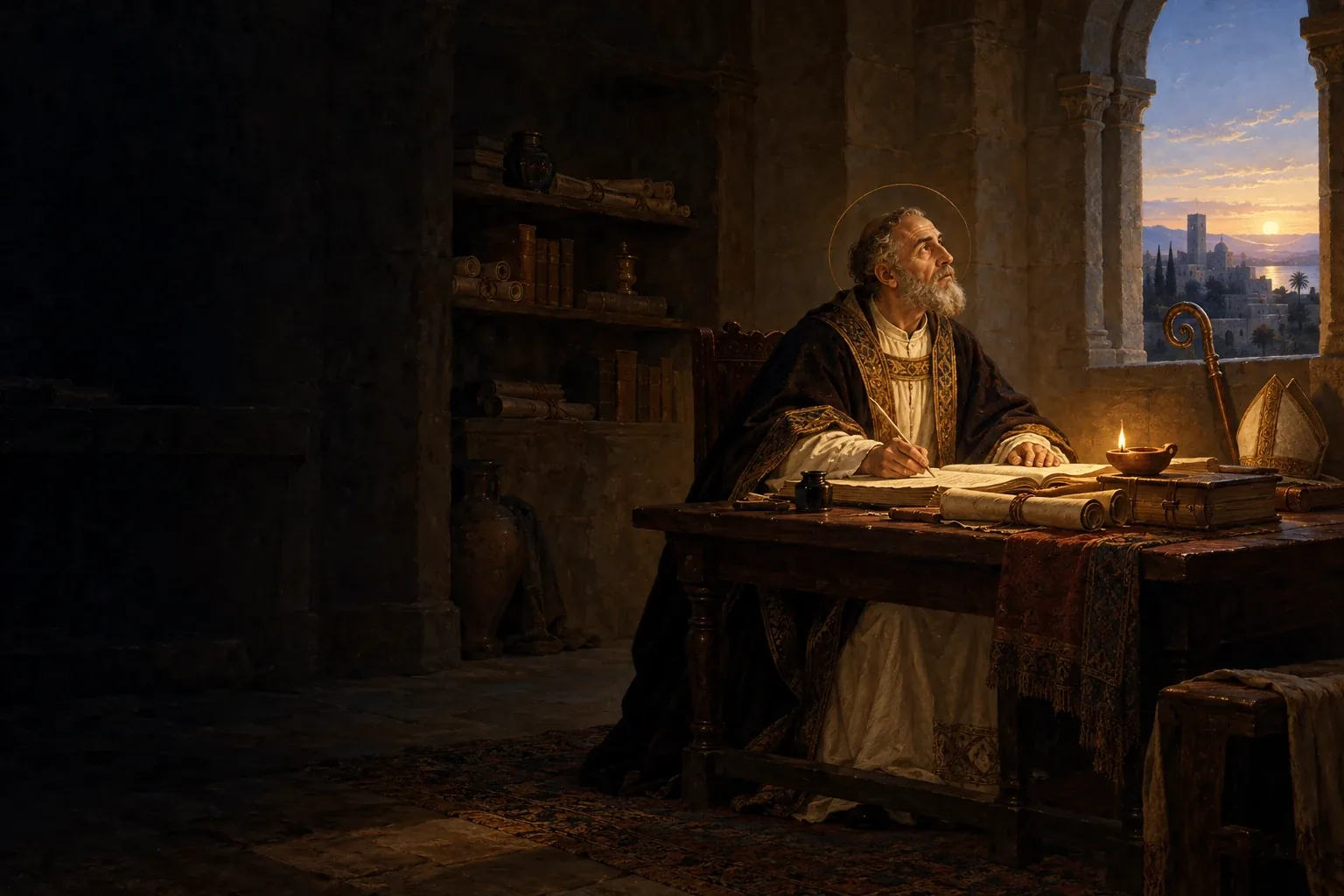
AI-generated image, directed by MZE
Today
A precious deposit
… that well-grounded system which tends to man’s salvation, namely, our faith; which, having been received from the Church, we do preserve, and which always, by the Spirit of God, renewing its youth, as if it were some precious deposit in an excellent vessel, causes the vessel itself containing it to renew its youth also.
All the passages
Saint Augustine of HippoBishop of Hippo and Doctor of the Church, died 430 · feast 28 August Our heart is restless · Wholly full of Thee · We shall rest and see · The word is added to the element · O sign of unity! · Desire exercised in prayer 6 passages
Saint Augustine of Hippo — life, feast and tomb
Our heart is restless
Great art Thou, O Lord, and greatly to be praised; great is Thy power, and of Thy wisdom there is no end. And man, being a part of Thy creation, desires to praise Thee … Thou movest us to delight in praising Thee; for Thou hast formed us for Thyself, and our hearts are restless till they find rest in Thee.
Wholly full of Thee
When I shall cleave unto Thee with all my being, then shall I in nothing have pain and labour; and my life shall be a real life, being wholly full of Thee. But now since he whom Thou fillest is the one Thou liftest up, I am a burden to myself, as not being full of Thee.
We shall rest and see
God Himself, who is the Author of virtue, shall there be its reward … He shall be the end of our desires who shall be seen without end, loved without cloy, praised without weariness. … There we shall rest and see, see and love, love and praise. This is what shall be in the end without end.
The word is added to the element
Why does He not say, Ye are clean through the baptism wherewith ye have been washed, but “through the word which I have spoken unto you,” save only that in the water also it is the word that cleanseth? Take away the word, and the water is neither more nor less than water. The word is added to the element, and there results the Sacrament, as if itself also a kind of visible word.
O sign of unity!
It is for this that the Apostle Paul, expounding this bread, says: “One bread,” saith he, “we being many are one body.” O mystery of piety! O sign of unity! O bond of charity! He that would live has where to live, has whence to live.
Desire exercised in prayer
Why this should be done by Him who “before we ask Him knoweth what things we have need of,” might perplex our minds, if we did not understand that the Lord our God requires us to ask not that thereby our wish may be intimated to Him, for to Him it cannot be unknown, but in order that by prayer there may be exercised in us by supplications that desire by which we may receive what He prepares to bestow.
Saint MonicaMother of Saint Augustine, as he recorded her last words · feast 27 August Remember me at the Lord’s altar 1 passage
Saint Monica — life, feast and tomb
Remember me at the Lord’s altar
Lay this body anywhere, let not the care for it trouble you at all. This only I ask, that you will remember me at the Lord’s altar, wherever you be.
Saint Irenaeus of LyonsBishop of Lyons and Doctor of the Church, died c. 202 · feast 28 June The glory of God is a living man · A precious deposit · In accordance with the Eucharist · As if she had but one soul 4 passages
Saint Irenaeus of Lyons — life, feast and tomb
The glory of God is a living man
For the glory of God is a living man; and the life of man consists in beholding God. For if the manifestation of God which is made by means of the creation, affords life to all living in the earth, much more does that revelation of the Father which comes through the Word, give life to those who see God.
A precious deposit
… that well-grounded system which tends to man’s salvation, namely, our faith; which, having been received from the Church, we do preserve, and which always, by the Spirit of God, renewing its youth, as if it were some precious deposit in an excellent vessel, causes the vessel itself containing it to renew its youth also.
In accordance with the Eucharist
But our opinion is in accordance with the Eucharist, and the Eucharist in turn establishes our opinion. For we offer to Him His own, announcing consistently the fellowship and union of the flesh and Spirit. For as the bread, which is produced from the earth, when it receives the invocation of God, is no longer common bread, but the Eucharist, consisting of two realities, earthly and heavenly; so also our bodies, when they receive the Eucharist, are no longer corruptible, having the hope of the resurrection to eternity.
As if she had but one soul
The Church, though dispersed through our the whole world, even to the ends of the earth, has received from the apostles and their disciples this faith … having received this preaching and this faith, although scattered throughout the whole world, yet, as if occupying but one house, carefully preserves it. She also believes these points [of doctrine] just as if she had but one soul, and one and the same heart, and she proclaims them, and teaches them, and hands them down, with perfect harmony, as if she possessed only one mouth.
Saint Ignatius of AntiochBishop of Antioch and martyr, died c. 107 · feast 17 October There is the Catholic Church · I am the wheat of God · Better to die for Christ · The medicine of immortality 4 passages
Saint Ignatius of Antioch — life, feast and tomb
There is the Catholic Church
Wherever the bishop shall appear, there let the multitude [of the people] also be; even as, wherever Jesus Christ is, there is the Catholic Church.
I am the wheat of God
I am the wheat of God, and let me be ground by the teeth of the wild beasts, that I may be found the pure bread of Christ.
Better to die for Christ
It is better for me to die in behalf of Jesus Christ, than to reign over all the ends of the earth.
The medicine of immortality
Stand fast, brethren, in the faith of Jesus Christ, and in His love, in His passion, and in His resurrection … breaking one and the same bread, which is the medicine of immortality, and the antidote which prevents us from dying, but a cleansing remedy driving away evil, [which causes] that we should live in God through Jesus Christ.
Saint Cyprian of CarthageBishop of Carthage and martyr, died 258 · feast 16 September The Church for his mother · When we call God Father 2 passages
Saint Cyprian of Carthage — life, feast and tomb
The Church for his mother
The spouse of Christ cannot be adulterous; she is uncorrupted and pure. She knows one home; she guards with chaste modesty the sanctity of one couch. She keeps us for God. … He can no longer have God for his Father, who has not the Church for his mother.
When we call God Father
We ought then, beloved brethren, to remember and to know, that when we call God Father, we ought to act as God’s children; so that in the measure in which we find pleasure in considering God as a Father, He might also be able to find pleasure in us. Let us converse as temples of God, that it may be plain that God dwells in us.
Saint AthanasiusBishop of Alexandria and Doctor of the Church, died 373 · feast 2 May He was made man 1 passage
Saint Athanasius — life, feast and tomb
He was made man
For He was made man that we might be made God; and He manifested Himself by a body that we might receive the idea of the unseen Father; and He endured the insolence of men that we might inherit immortality.
Saint Justin MartyrPhilosopher and martyr, died c. 165 · feast 1 June On the day called Sunday 1 passage
Saint Justin Martyr — life, feast and tomb
On the day called Sunday
And on the day called Sunday, all who live in cities or in the country gather together to one place, and the memoirs of the apostles or the writings of the prophets are read, as long as time permits; then, when the reader has ceased, the president verbally instructs, and exhorts to the imitation of these good things. Then we all rise together and pray, and, as we before said, when our prayer is ended, bread and wine and water are brought, and the president in like manner offers prayers and thanksgivings, according to his ability, and the people assent, saying Amen; and there is a distribution to each, and a participation of that over which thanks have been given.
Saint Leo the GreatPope and Doctor of the Church, died 461 · feast 10 November Christian, acknowledge thy dignity · Changed into a sacramental presence 2 passages
Saint Leo the Great — life, feast and tomb
Christian, acknowledge thy dignity
Christian, acknowledge thy dignity, and becoming a partner in the Divine nature, refuse to return to the old baseness by degenerate conduct. Remember the Head and the Body of which thou art a member. Recollect that thou wert rescued from the power of darkness and brought out into God’s light and kingdom.
Changed into a sacramental presence
And so that which till then was visible of our Redeemer was changed into a sacramental presence, and that faith might be more excellent and stronger, sight gave way to doctrine, the authority of which was to be accepted by believing hearts enlightened with rays from above.
Saint John DamascenePriest and Doctor of the Church, died c. 749 · feast 4 December An uprising of the mind to God 1 passage
Saint John Damascene — life, feast and tomb
An uprising of the mind to God
Prayer is an uprising of the mind to God or a petitioning of God for what is fitting.
Saint Gregory NazianzenBishop and Doctor of the Church, died c. 390 · feast 2 January We call it the Gift 1 passage
Saint Gregory Nazianzen — life, feast and tomb
We call it the Gift
We call it the Gift, the Grace, Baptism, Unction, Illumination, the Clothing of Immortality, the Laver of Regeneration, the Seal, and everything that is honourable. We call it the Gift, because it is given to us in return for nothing on our part; Grace, because it is conferred even on debtors; Baptism, because sin is buried with it in the water; Unction, as Priestly and Royal, for such were they who were anointed; Illumination, because of its splendour; Clothing, because it hides our shame; the Laver, because it washes us; the Seal because it preserves us, and is moreover the indication of Dominion.
Saint Cyril of JerusalemBishop of Jerusalem and Doctor of the Church, died 386 · feast 18 March Like a mustard seed 1 passage
Saint Cyril of Jerusalem — life, feast and tomb
Like a mustard seed
For the articles of the Faith were not composed as seemed good to men; but the most important points collected out of all the Scripture make up one complete teaching of the Faith. And just as the mustard seed in one small grain contains many branches, so also this Faith has embraced in few words all the knowledge of godliness in the Old and New Testaments.
Saint AmbroseBishop of Milan and Doctor of the Church, died 397 · feast 7 December The word of Christ changes 1 passage
Saint Ambrose — life, feast and tomb
The word of Christ changes
Let us prove that this is not what nature made, but what the blessing consecrated, and the power of blessing is greater than that of nature, because by blessing nature itself is changed. … Shall not the word of Christ, which was able to make out of nothing that which was not, be able to change things which already are into what they were not? For it is not less to give a new nature to things than to change them.
Saint John ChrysostomBishop of Constantinople and Doctor of the Church, died 407 · feast 13 September Thou hast tasted the Blood of the Lord · What a husband says to his wife 2 passages
Saint John Chrysostom — life, feast and tomb
Thou hast tasted the Blood of the Lord
Thou hast tasted the Blood of the Lord, and not even thereupon dost thou acknowledge thy brother. Of what indulgence then art thou worthy? Whereas if even before this thou hadst not known him, thou oughtest to have come to the knowledge of him from the Table; but now thou dishonorest the Table itself; he having been deemed worthy to partake of it and thou not judging him worthy of thy meat.
What a husband says to his wife
I have taken thee, my child, to be partner of my life, and have brought thee in to share with me in the closest and most honorable ties, in my children, and the superintendence of my house. … For these reasons then, I courted thee, and I love thee, and prefer thee to my own soul. For the present life is nothing. … I value thy affection above all things, and nothing is so bitter or so painful to me, as ever to be at variance with thee.
Saint Basil the GreatBishop of Caesarea and Doctor of the Church, died 379 · feast 2 January Through the Holy Spirit · The honour paid to the image 2 passages
Saint Basil the Great — life, feast and tomb
Through the Holy Spirit
Through the Holy Spirit comes our restoration to paradise, our ascension into the kingdom of heaven, our return to the adoption of sons, our liberty to call God our Father, our being made partakers of the grace of Christ, our being called children of light, our sharing in eternal glory, and, in a word, our being brought into a state of all “fulness of blessing.”
The honour paid to the image
… and so the doxology ascribed by us is not plural but one; because the honour paid to the image passes on to the prototype. Now what in the one case the image is by reason of imitation, that in the other case the Son is by nature.
The DidacheThe Teaching of the Twelve Apostles, a Christian writing of the first century Thou shalt not kill 1 passage
Thou shalt not kill
… thou shalt not practice witchcraft, thou shalt not murder a child by abortion nor kill that which is begotten. Thou shalt not covet the things of thy neighbour.
The passages were chosen because the Catechism of the Catholic Church cites them; each reference was checked on vatican.va. The English is the public-domain translation of the Ante-Nicene Fathers and Nicene and Post-Nicene Fathers (ed. Roberts, Donaldson and Schaff, 1885–1900); the Catechism’s own wording is a newer translation and may differ. “…” marks lines left out.